Wisconsin Parts Database Instructions and Discussion Team/Group > INDIANA
> Motors and tools
> Remove
> Used
> Without Warranty
> New 7 premier dental laser hard tissue centauri er yag
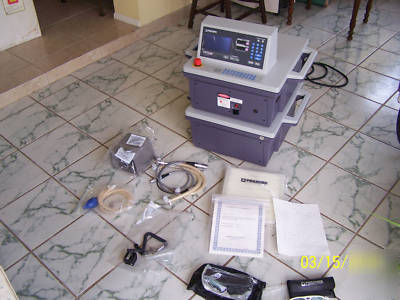
New 7 premier dental laser hard tissue centauri er yag
The laser system is called the Centauri Er:YAG, which stands for erbium (a crystal that generates the wavelength), yttrium, aluminum and garnet (metals and crystals that help control the laser beam).
The Premier laser is superior to drills because it better sterilizes the area of the tooth where the decay is removed, which could also inhibit future decay
The Centauri Er:YAG dental laser can be used for hard tissue surgery such as removing tooth decay and preparing a cavity for a filling. The laser can also be used for hemostasis, excision, and vaporization of tissues in various medical applications.
The only way to treat tooth decay, technically known as dental caries, is by cutting away the decaying portion of the tooth, a procedure that is done almost 170 million times a year. Until about five years ago, the only way to do that was with the standard handpiece, commonly known as the dental drill, a device that dates to the 1700s
The laser has several benefits over the handpiece: Because laser treatment is usually painless, there is no need for anesthesia or anesthetic injections in many patients, and dentists do not have to wait until their patients' mouths are numb to begin treatment. Also, the laser eliminates the vibrating sensations of the high-speed handpiece.
Also, compared with the standard handpiece, the laser can work with better precision, saving more of the healthy tooth. And when the laser procedure is done, patients do not have to wait for the numbness and puffiness related to the use of anesthesia to fade.
For many patients, especially those particularly fearful of the dental drill, the laser has drawn rave reviews. "My patients love it," says Edward Romano, a dentist in Morristown, N.J., who has used the laser since 1997. "They say: 'I can't believe it's so comfortable, that dentistry has come this far.'"